
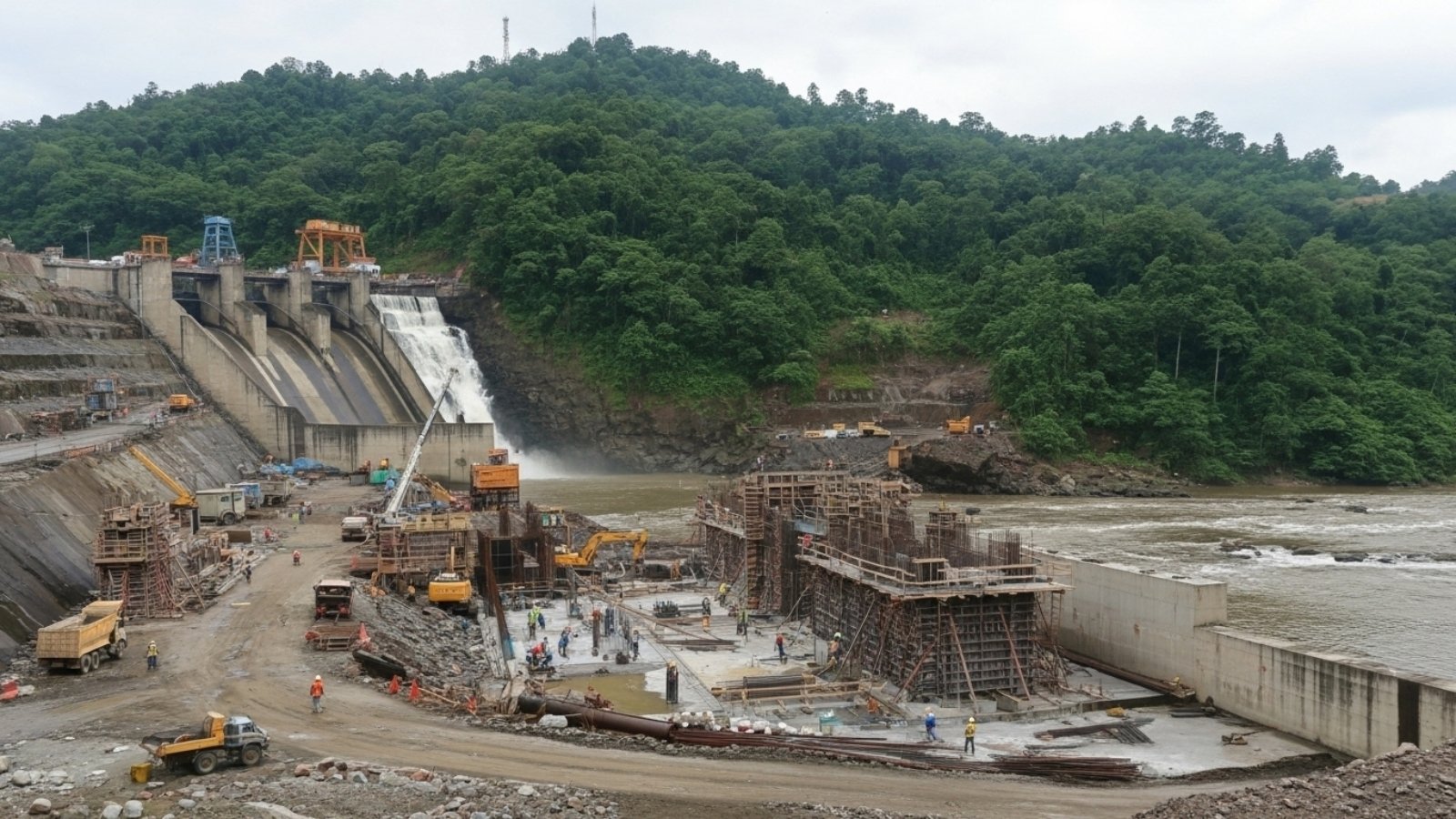
Major infrastructure projects like the 450 MW Mamfe Hydropower Plant require precise planning and execution over many years. This week, we outline the projected timeline, detailing the major phases, key milestones, and the ultimate target date for injecting the first power into Cameroon’s national grid.
The Overall Schedule and Duration
While the pre-construction phase (feasibility studies, design, financing) often takes up to 8–10 years for large hydropower, the physical construction phase for a project of Mamfe’s scale (around 450 MW) is typically estimated to be between 5 to 7 years from the financial close and the start of excavation.
Based on comparable regional projects and the complexity of dam construction, the estimated schedule for Mamfe is:
Phase Duration Target Start Year Target Completion Year
Pre-Construction (Financing & Detailed Design) Completed (Q4 2025) 2018 2025
Civil Works & Construction 5 – 6 Years Q1 2026 Q4 2031
Electromechanical Installation 2 – 3 Years (Concurrent) Q1 2029 Q2 2032
Reservoir Impoundment 6 – 12 Months Q4 2031 Q3 2032
Commissioning & First Power 6 Months Q3 2032 Q4 2032
Export to Sheets
The ambitious target for First Power from the Mamfe Project is late 2032.
Key Construction Phases and Milestones
The construction process involves four distinct, overlapping phases.
Phase 1: Preparation and Diversion (Year 1)
This phase prepares the site for the major civil works and protects the construction area from the river flow.
Access and Infrastructure: Construction of access roads, camps, quarries, and concrete batching plants.
River Diversion: This is the first critical milestone. It involves building temporary cofferdams upstream and downstream, and either blasting diversion tunnels or constructing a channel to safely route the river’s flow away from the main construction site. This allows the foundation to be built on dry ground.
Phase 2: Dam and Powerhouse Civil Works (Years 2 – 4)
This is the most time-intensive and capital-heavy phase, involving the heavy-duty structural construction.
Foundation Excavation: Preparing the bedrock foundation for the dam and powerhouse to ensure maximum stability and water tightness.
Dam Construction: Building the main dam structure (concrete or rock-fill) to its full height, including spillways and intake structures.
Major Milestone: Dam Crest Reached (Closure of the last block, allowing for control of water levels).
Powerhouse Shell: Construction of the massive reinforced concrete structure that will house the turbines and generators.
Phase 3: Electromechanical Installation (Years 3 – 5)
While the civil works for the dam are nearing completion, the technical equipment is installed in the powerhouse.
Turbine and Generator Assembly: Installation of the main electromechanical equipment the Kaplan turbines and synchronous generators which will convert the water’s energy into electricity.
Transmission Lines: Construction of the high-voltage transmission line (evacuation line) from the powerhouse switchyard to the national grid connection point.
Control Systems: Installation and testing of the control room, transformers, and electrical switchgear.
Phase 4: Impoundment and Commissioning (Year 6)
The final phase involves filling the reservoir and rigorously testing the plant systems.
Reservoir Impoundment: After the diversion tunnels/channels are permanently closed, the reservoir begins to fill. This is a crucial environmental and structural milestone.
Wet Commissioning: Water is introduced to the penstocks and turbines, and each generation unit is tested individually under real operating conditions.
Final Milestone: First Synchronization to the Grid (The first injection of electricity, known as “First Power”).
The Role of Timely Delivery
Delivering the Mamfe Project on schedule is vital for Cameroon’s economic goals. Every delay increases the reliance on expensive thermal (diesel) power, resulting in higher operating costs for the national utility and increased power instability for businesses and households. The PPP structure holds the private developer accountable, with financial penalties tied to missed delivery dates.
The successful completion of the Mamfe Hydropower Project will be a monumental achievement, not only for the country’s energy security but as a testament to efficient project management in Africa.